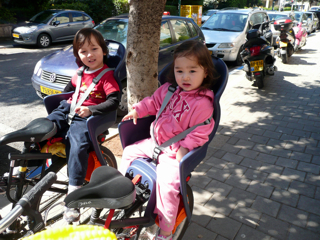
Monday, April 25, 2011

Zen and the art of Sebastianisms


I think my four and a half year old son can write a book on Zen and the Art of Cleaning the House. Or Zen and the Art of Making a Salad. It’s quite refreshing to see kids get excited about the things many of us consider chores. This week has been an especially exciting, or shall I say “zen” week. “It’s for Passover!” Sebastian exclaimed every time I passed by him as he was sweeping or vacuuming the floor. The ritual of cleaning the home in preparation for the holiday must have been a very effective and memorable lesson at his gan.

The cleaning, and the ten plagues, which he spews rhythmically, teetering between blood, locusts, and vermin, all the way to the climactic slaying of the firstborn (מכת בכורות), to which he adds casually, “all the boys die”. Sebastian’s enduring involvement with the subject of death, in light of the holiday spirit, has been a little less sunny, but no less sensitive and impassioned. The spirit of thankfulness (דיינו; Dayenu -- “it would have been enough”) that is appropriate to the Passover theme of freedom rings in his energized pronouncement one evening during dinner: “How awesome it is (’איזה כייף’) that I wasn’t in Egypt and that they didn’t kill me!”  The deep sense of gratitude that swept over him, presumably, came on the heels of a rather calculated reflection from an earlier evening: “It’s really not fun (’ממש לא כייף’) for people who die.” [To my prod, why? (I couldn’t resist) -- “because they can’t get to know Israel better and go to Canada…”]

Sebastianisms, this blog should be called. I marvel at the stuff he says. The other day, walking uphill after a morning at the beach, he stops, legs slightly spread, and says, looking down: “How is it that our feet are so small and can support us?” My immediate and enthusiastic response to his sensitive query was what has by now become my form response: a simple -- at once aborted and pregnant response -- that is elicited by a sense of emotional awe and intellectual shortcoming at once: “what a wonderful question…!” I walked up the hill more aware of my body, more cognizant of my feet's contact with the ground, and marveled at our amazing instruments and at the harmonious complexity of our physiology.

Later on that afternoon, while sitting on a bench eating popsicles at the playground, Sebastian said: “Ima, listen to the birds. “Just the birds,” he added, “not the children.” I tilted my head, squinted, and strained to discriminate between the manifold sounds surrounding me. I tried to isolate, to concentrate, to listen. This was an exercise in focus, in mindfulness, and I accepted the challenge.

Then came a happy “sound of the children” that I could not ignore. It was rhythmic, spirited, and very very familiar: “Hayom Yom Huledet le-Liliana” (Happy Birthday to Liliana). As far as my two year old is concerned, every day is her birthday. And she declares it. Loudly. Boldly. In song. Hers is a sense of entitlement that is refreshing, undaunted, and positive.  Her vital confidence is buoyant and almost enviable. We all join in song.

Life is too serious to be taken seriously. But life in the home of a toddler and a preschooler also serves up the flipside: play is too serious to be taken lightly. No plastic strawberry is placed haphazardly, no balloon is stapled on casually, no stuffed animal is positioned accidentally.

Sebastian dresses up from head to toe for a pretend birthday party. Liliana hauls the pillows and the blankets for a pretend nap (this one’s fast becoming my favorite of the pretend games; being read to and tucked in by a two year old is a great perk). The point is: everything is deliberately planned; and vigorously executed. 

I’ve been reading other women’s (Tina Fey, Sarah Kay) sharp, poetic, and stirring passages on the subject of “what I want to tell my children”. I ask myself what I want to tell mine. And shrug. I haven’t yet figured it out. But I do know what I want to learn from my children.

I want to inhabit their sense of wonder. To see a snail in the pile of poop in the potty. I want to attain their emotional openness. To go from tears to laughter instantly with the help of a silly distraction. I want to absorb their sense of privilege. To holler “it’s my birthday” in song. Even when it’s not my birthday. I want to seize their joy. To crack up at a silly impersonation. To gush at the beautiful foolishness of little things. I want to live lightly, and play seriously. To approach everything with deliberation. And enthusiasm.

Ponyboy, in S.E. Hinton’s gem of a coming-of-age novel The Outsiders says: “Nothing gold can stay.” Robert Frost’s simple truth has always touched a tender and wistful nerve in me.


 And yet the one thing I find myself wanting to tell my children, is: “Stay golden.” 

Saturday, March 12, 2011

A Sunny Death


“Ima, I want kaftorim surgery,” I hear Sebastian calling out in a drone from the kitchen. Kaftorim is the Hebrew medical name given to middle ear surgery designed to treat excess ear fluids.

Earaches are commonplace for Sebastian, misken (poor soul), and visits to Dr. Rosenzweig, Ear Nose and Throat specialist, are routine. On our walk back home after our last follow-up visit with Rosenzweig, my dear child turned to me and pronounced offhandedly: “Ima this whole business with the ears is really quite annoying.” I had to agree. And to add that we’re addressing it and that we’ll take care of the situation and resolve it. I was surreptitiously thrilled when the doctor, after numerous months of visits and follow-ups, resorted to suggesting surgery. I swiftly added to my sweet and fragile gibor (brave hero), that a special fruit shake and a sweet treat were his for the choosing.

“You’ll have the surgery,” I assure him keenly, as the seams in my heart splinter. The sight of this child, face thrust forward, hands pressed against his small and inquiring ears is heartrending. “Wednesday!” I pronounce in a cheerful tone, and the faint smile that forms on his face creases my heart. This kaftorim surgery is looking to be the highlight of our week. I myself have been stealthily envisioning our post-surgery chocolate pizza at the Max Brenner Chocolate Café that is tactically situated directly across Assuta hospital in the Ramat Hachayal district of Tel Aviv. And I have to own up to the enchanting visions of helium balloons and candy and ice cream and flowers that have been permeating my dreams.

Besides kaftorim ear surgery, there are additional proceedings that our four year old is looking forward to with great anticipation.

Dying on a sunny morning, for example. At the age of 100 mind you, but still, the foresight is scrupulous and the expectancy is hearty.

Why in the morning? “Because I need to be wearing pants with pockets so that I have enough room to hold all the things that I want to die with.”

But the time of day is only a single thread in the bound web of deliberation that this child has woven: “I want it to be a sunny day when I die. Sunny days are the only truly perfect days for dying. Because I don’t want my drawing to blow away in the wind, or to get wet in the rain. I really hope it’s sunny when I die.”

He has even picked out the shirt he wants to die in: RED with monkey musicians!

He is attentive to detail, meticulous, and thorough in his planning.

I watch Sebastian’s thought processes in motion and think: I wish I could plan my life as methodically as this child plans his death.

It’s true. I really can learn from him. About the importance of making lists, of writing things down, of taking multiple factors into consideration, of prudence and of prescience.

All valuable stuff in this trying to figure out what to do with my life phase.

At peepee shel chatul” – “you are cat peepee” – I hear a laughing voice gurgle and break my meditative state. I respond to it and am instantly drawn into the currently popular diversion of back-and-forth directed nonsensical dialogue with a disarming two year old – “at (you are) mooki”; “at pooki”; “at keeka”; “at koola” – allowing the sparkling laughter that accompanies each and every utterance to soften my chest and slide down into my gut before rising and surging into the atmosphere. 

The other child is sensory, intuitive, and rolls from the gut. This is a child who knocks back her antibiotics as she flips headfirst from table to couch.  

I meditate on the importance of both dynamics – the reflective and the intuitive - and on the desire to tread the fine bar between the two.  Surely this is an evolving and ongoing process. Like parenting.

Parenting comes with a steep learning curve. I’m thankful for my two little mentors. They make life sunny.

Monday, February 21, 2011

Food, Glorious Food


“I should write a book about conversations with Israeli taxi drivers”, I exclaimed to Lance upon returning late one night from a one-woman-show at the innovative and experimental Tmuna Theatre. After fixing myself a smooth milky nescafe and a side of chocolate wafers for dipping (a hot drink without a little sweet nosh is unheard of in my family and in this country), I grabbed my notebook and started jotting down bits and pieces of dialogue (rather, monologue) so that I wouldn’t forget the colorful morsels of conversation that were delivered en route. As I wrote, sipped, dipped, and nibbled, the national blended with the personal. And I came to realize there was a pungent common motif here: food, glorious food.

On our way back from a meeting in the southern part of the city (pre-bicycles), our taxi driver speaks loudly and brazenly on his phone, as is the modus operandi here, in an inimitable mix of Arabic and Hebrew: “Yalla, come meet me for lunch at the Hyatt. What do you mean? Nah, “shtuyot”, bullshit, it ends up costing the same wherever you go. Business lunch. Yalla, I’m in the mood for some fish and potatoes. Challas, I don’t want to eat pita and hummus again.  Nu, are you coming?”

On my way to see a show in a rather seedy part of town, my taxi driver motions: “you see this place over here? It’s good, fairly new. They serve these sandwiches… but they pack them with too much meat. Blech. How can anyone eat it like that? I like my meat but come on. So I said to them: do me a favor, give me another couple slices of bread, I’ll pay for it, to make a decent sized sandwich. Something I can enjoy. I want something that I can fit in my mouth, that’s pleasant in the mouth. So much meat like that, it’s not pleasant in the mouth. I told him my grandmother would have said that such oversize sandwiches are “unappetitlich” (unappetizing).

On my way back home, my husky voiced taxi driver with the ponytail (only when she spoke in the feminine did I become aware that this was a woman), asked me if I am hungry and offered me what she called a “biton” (brick) cookie. Her mother’s recipe: A family tradition. No one in the family can refuse them. They’re hard as rock but they’re tasty. Her mother was something else. She misses her like crazy. She visited her everyday during the last ten years of her mother’s life when she was suffering from alzheimers and couldn’t remember a soul. Everyday except for Yom Kippur because you can’t drive on Yom Kippur. I could only mumble in concurrence as I munched and munched and munched on the very solid and very savory slabs of sesame.

I was struck by the fitting tenor of this driving monologue in view of the one-woman-show I had just emerged from, titled “No longer anybody’s daughter”, about the performer’s coming to terms with her mother’s death.

I sunk into the backseat and found myself thinking of my grandmother’s heart shaped butter cookies. And of my mother’s relationship with the beygale.

There is nothing like a post-show beygale (sesame crusted cross between a bagel and a pretzel) that seals an evening at the theatre and leaves you sated with the evening’s experience. My mother’s visit here, to my delight, was filled with theatre events. Time and again, upon exiting the theatre, inspired and moved, my mother’s characteristically brisk gait would significantly intensify. I’d leave it to her to wedge her way between the clambering people answering to the call of “beygale cham” and happily much on a beygale on the way home. The nonappearance of the beygale man on some occasions was so entirely unfulfilling that it called for an express stop elsewhere. On my mother’s next visit, I’ll know exactly where to take her when the beygale man fails to deliver. Since the recent opening of the new Ibn Gvirol branch of the Jaffa bakery-cum-institution, there is Abulafia to salvage the evening.

My mother’s course is often savory. With my grandmother it was always sweet. I remember seeing a movie or a concert with Safta and returning to her apartment to sit together savoring kaffe und kuchen (coffee and cake). The hot chocolate and the cheese Danish that we’d shared during intermission didn’t diminish the craving for sweetness. I think of her often, my Safta, for whom this country was home.

I recall the way her eyes sparkled and the way her hands danced to the sounds of Yossi Banai or Edith Piaf. I picture the way she scooped jam onto a crusty roll -- with a spoon, never a knife. I summon up the story about the time she came back from the kiosk with TWO ice creams because she couldn’t decide which one to get. This was a woman who chose to eat ice cream for dinner. And desert. A woman who was the inspiration for the decadent yet simple “ice cream celebration” dessert featured at our Vancouver restaurant Bridges: loads of ice cream and a heaping helping of chocolate sauce.  A woman whose warm heart and sweet tooth were inextricably entwined.

How I would love to sit with her today and have an ice cream with her and with my children whom she never got to meet.


In our home, “glida” (ice cream) was a close contender to ‘Aba’ and ‘Ima’ as far as baby’s first words go. My little one, age two, wants only to hear songs about chocolate, candies, and ice cream. I am happy to invent such songs and to sing them to her.


 In the photo that I keep of Safta that was taken in December 2002, a few weeks before she passed away, she is eating a sufganya.  When I showed Sebastian, my four year old, this photo of her, he asked where she is. I told him that she’s in a sweet sweet faraway place. He wants to go there. But we’re here. In the now: taking and savoring every opportunity to eat ice cream. 

Saturday, February 5, 2011

Of death and lies


“I can’t see. He’s blocking my view,” Sebastian pronounced while we were gathered around the ceremonious table at a friend’s newborn’s Bris. I lifted him up high and prepared to deal with his inexorable questions in the most passable and cursory manner possible. “What is he doing to the baby?” “I want to see.”

This is a kid who wants to observe and comprehend everything.

It’s a ceremony that welcomes the new baby to the world. The rabbi just needs to give him a little injection (incision, same thing) to make him healthy. Kind of like a flu shot or a blood test. Just a little “pique” and it’s over. Now he’s putting sweet juice (wine, same thing) in his mouth to make him feel better.

Whew. I figure the flu shot/blood test analogy will go over well enough. We have just emerged from a week of getting the kids’ blood tests done; two separate heavily involved events that included lots of waiting, counting numbers (of people ahead of us), indulging complimentary neighbors with small talk, tight holding, hugging, and caressing, and tall tales of bravery. By and large, the most mundane events involving the kids are… involved.

After a couple faint wails, the baby was placed in his crib. I watched Sebastian and Liliana join hands and dance joyously with the happy families of the newborn and sighed. This parenting thing is becoming an ongoing exercise in improvisation.

“What does the pee-pee fairy look like?”

pee-pee fairy, for those uninitiated, is a kindred sister to the poo-poo fairy, guiding the night-time transition to dryness:
long wavy purple hair, a pink and green dress with flowers, and green sparkly shoes.

“Why does the picture of the flower not have a stem?”
                        maybe it’s just a decoration, like a symbol, like sometimes we draw a face without the  
                        body right?

 “Why do dead people not have to breathe?”
                        they’re in a place where they can just rest

Questions on the dead invariably come in clusters. Death is a subject of immense fascination as of late. Not because of any real-life personal experience with the matter, mercifully. It all began with reading the poet biographies in Sebastian’s Hebrew children’s poetry anthology. Once he understood that not ALL poets are dead, he started orchestrating a head count of living vs. dead poets (brimming with enthusiasm: “Meir Shalev is alive? יואו! "Yo (Hebrew equivalent of “Yay”,) nine living authors, what fun!!” איזה כייף!

“What airplane do the dead people take to get to their special place?”
                   Um… well, you know, when they die, they grow wings and fly!

WTF???!!!

Put on the spot, in the spur of the moment, I make shit up. Moments later, I find myself disparaging myself: Really? What in the world did I just say? Jesus, I can’t believe I’m lying to my kid.

The spiral effect that twists through the arena of lies takes all prisoner; white, black, and floral patterned rainbow colored lies get tangled in its coiled web.

We can’t maintain this “special surprise from the pee-pee fairy thing every night,” Lance and I concur. Alright, what new lie can we make up about the protocols of the enigmatic pee-pee fairy? And so it goes: on and on, around and around.

With the passage of time, I imagine, we will negotiate the path of rapprochement –dusting off the lies, sharpening their round edges, and joining them with the truth. Time, I expect, will guide us as we -- at turns hesitantly, at turns bravely – wet our feet in this ongoing game of improv, this enduring puzzle of parenting.


The passage of time is something our pensive four year-old seems to grasp keenly; he no longer asks how old will you be when I’m eighty, but how old will I be when you’re dead?” (A lump lodges in my throat and sinks into my heart). To boot: “Aba is almost dead because he’s already forty.”

The other morning I went to get my own blood tests done. A short wait, no conversation strikers, no constant chatter, no one fastened to my body. I have to admit I felt rather alone when I sat on the chair in the clinic, a Russian nurse drawing her needle in front of me, with no child to hold me.

That afternoon, I picked Sebastian up from gan at 1:30 pm as usual, took him home as usual, served him lunch as usual, and then, instead of quickly gathering his (stuffed animal) “friends”, dropping him on the couch (his day bed), uttering the word “schlaffstunde” (naptime), and rushing out of the room to get to the computer, I brought him into my bed, lay next to him, and snuggled.

My dad said to me the other night that the most precious and important thing in life is time. I think he’s right. Time-outs have their place in the practice of parenting. I’d like to usher in the time-ins.

Monday, January 17, 2011

All of these (things)


“Write it down”, I am commanded regularly by my four year old son, “so that we don’t forget.” List making has become routine. I try to obey and indulge him promptly. I recognize the urgency in his voice and am familiar with the poignant tears that well in his eyes when he feels that something risks being lost.  At age four, things are very important. The enthusiasm and the beaming smile that inflect his voice as he recites these vital lists are heartening. 

Many lists are sugary sweet: chocolate, m & m’s, gummy bears, skittles. Some are playful: a parrot in a hot air balloon, a horse in an airplane, a rabbit in a tractor. Still others are rather pensive. The other day, Sebastian asked me to write down a list of his favorite Hebrew poets: H.N. Bialik, Leah Goldberg, Fanya Bergstein, Miriam Yallan Shtekelis, Ayin Hillel, Leah Naor, Naomi Shemer, Yehonatan Geffen.  They are all important: all of these things.


There is a song by Hebrew poet Naomi Shemer that speaks of “all these things – of the honey and of the sting, of the bitter and the sweet, of the burning fires and the pure waters, of the baby daughter and of the man who returns home from a great distance”. 
על כל אלה על כל אלה
שמור נא לי אלי הטוב
על הדבש ועל העקץ
על המר והמתוק
Naomi Shemer entreats the good Lord to watch over and safeguard all of these things: the honey and the sting, the bitter and the sweet.

It’s “all of these things” that get to me. Here, it seems, the emotional spectrum is expansive, and the sensations along the spectrum, mercurial.  I have, for a long time now, been in awe of the speed with which young children can shift from an emotional intensity to another – from tears to laughter and vice versa.  As if the emotion and its attendant symptoms simply washes over them, and away, smoothly, effortlessly. I remember sitting cross-legged in “seated meditation” at a yoga class and contemplating the value of this phenomenon: not holding on to the emotion, not allowing it to hold onto you. As an actor, I marvel at the potential for the emotional range and truthfulness that this childlike phenomenon might yield if it were gleaned.

And here I am. A few months into our stint in this crazy place. Reduced to a childlike experience.

One moment I am riding my bicycle, along the sun drenched café-lined avenues, kid in tow, on top of the world, and the next moment I am laboring to lock the bike and stepping in dog-shit.

One moment Lance is beaming with the discovery that all the women who work at the music library speak Russian, and the next he is straining to be understood by the Ethiopian cashier at the supermarket.

One moment I am hopeful and excited over a promising phone call, and the next I am sitting dejected in front of the computer, disheartened with my stagnant search for information.

One moment Lance is grinning, returning home from the butcher with his black pepper crusted salami and chicken filets in hand, and the next he curses through hunger pangs at the realization that it’s Shabbat, meaning all the delis are closed.

One moment I am exchanging niceties with the juice guy who tells me he’s very fond of me and my cutie son, and the next I am reorganizing the weight of the grocery bags as I struggle to carry them home.


All these things, all of them, the bitter and the sweet, make up our daily experience here, during these initial laden months. And the swing from one extreme to the other is swift, robust and glaring.

The other day Sebastian told me that he wants to die next to Aba (his dad) and the early 20th century poet Bialik. He asked, to be sure, whether we are able to choose where we want to die, or whether אלוהים "Elohim" (God) decides.

I thought to myself, and didn’t say it to him, that we can’t choose when we die. And I went to hug him, in an effort to cling to “all of these” – כל אלה –– all these things that are a part of life, the bitter and the sweet.